





Minnesota High Tech Association
and
Science Museum of Minnesota Announce 2011 Minnesota Science and Technology
Hall of Fame Inductees
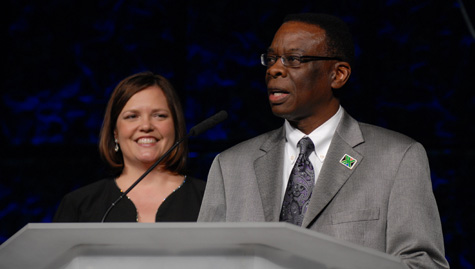
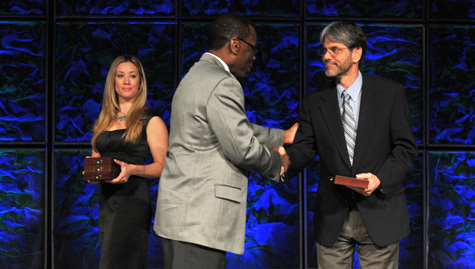
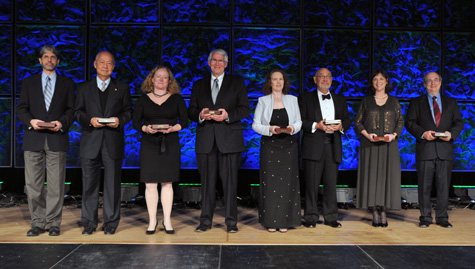
MINNEAPOLIS,— The Minnesota High Tech Association (MHTA) and the Science Museum of Minnesota inducted the fourth class of the Minnesota Science and Technology Hall of Fame at the 12th annual Tekne Awards ceremony on Nov. 3.
- Neal R. Amundson (Awarded post-humously): Mathematician and chemical engineer; University of Minnesota Regents professor widely regarded as the "Modern Father of Chemical Engineering;" transformative figure renowned for integrating sophisticated mathematical theory and modeling into chemical engineering practice; influenced generations of students as a distinguished professor and Chemical Engineering Department Head at the University of Minnesota and later, at the University of Houston.
Amundson was an elected member of the National Academy of Engineering, the National Academy of Science, and the American Academy of Arts and Sciences. He chaired the committee of top scientists called upon to set the national research agenda with the 1988 "Frontiers in Chemical Engineering" report of the U.S. National Research Council. He published over 200 articles and numerous books, with primary contributions in the areas of chemical reaction engineering, char gasification and combustion, polymer reaction engineering, thermodynamics of aerosols, and linear operator theory, a branch of pure and applied mathematics. In a career spanning more than 60 years, he re-defined the possible in his fields of study: a legacy that continues to evolve through the more than 50 PhD students he mentored. - Herbert C. Johnson (awarded post-humously): Engineer, business leader, leading advocate for advancement of Minnesota high tech industry and—more broadly—the fields of science/engineering; a founder and former chair of the Minnesota High Tech Council (now Minnesota High Tech Association); former President, Minnesota Technology Corridor Corporation
Johnson began his career working at Engineering Research Associates Inc. for William Norris of later supercomputer fame. He went on to become the first President of the precision testing firm MTS Systems, then President of Plymouth-based DataMyte Inc. He helped to found engineering programs at university campuses throughout the state, including University of MN-Duluth, St. Cloud State University, and Mankato State University. He was chair of the Minnesota Project Outreach Corporation—which links manufacturers with university experts—and a trustee of the Charles Babbage Institute. He is remembered both as a visionary for Minnesota's high tech industry, and a dedicated advocate for environmental causes, in particular, the Boundary Waters Canoe Area. - Benjamin Y.H. Liu: mechanical engineer and inventor specializing in aerosol research, a field devoted to study and management of airborne particles with particular respect to environmental contaminants; widely published University of Minnesota Regents Professor Emeritus and former director of its Particle Technology Laboratory; current president/CEO of MSP Corporation, manufacturing precision instruments that apply micro- and nano-particle technology to industrial applications.
Through his own research and as Director of the Particle Technology Laboratory, Liu advanced the state of the art in instrumentation for aerosol research. He has authored or co-authored over 400 publications, and has conducted research on fine particles and micro-contaminants found in settings ranging from the interior of a miner's lung to the interior of the Space Shuttle Columbia. He is a founding father of the American Association of Aerosol Research, fostering scientific and technical advancements related to air pollution, industrial hygiene, atmospheric sciences, clean room technology and nuclear safety. Elected to the National Academy of Engineering in 1987, he received the highest recognition in his field— the Fuchs' Prize—in 1994. He retired from the University of Minnesota after four decades of exemplary teaching and research, only to launch a new endeavor, MSP Corp. He holds over 60 patents for breakthrough technologies in aerosol research and related fields. - Richard W. Peterson: Physicist with broad research interests in optical measurements (spectroscopy, interferometry, plasma diagnostics), holographic measurements, musical acoustics, and prizewinning laboratory and demonstration apparatus for the teaching of physics; widely published and award-winning University Professor of Physics (now Emeritus) at Bethel University; currently Program Director in the Division of Undergraduate Education (DUE) for the Arlington, VA-based National Science Foundation; a leading worker for community-based STEM initiatives in Minnesota, with support from the Blandin (rural) and McKnight (urban) Foundations
Peterson was elected a Fellow of the American Physical Society and also received that society's prize for Outstanding Researcher at an Undergraduate Institution. He served as President of the American Association of Physics Teachers and has traveled globally as a Traveling Lecturer for the Optical Society of America. He is co-inventor of 3M U.S. and international patents for on-line optical measurements and has authored or co-authored over 100 papers in the physics community, including cover features in the American Journal of Physics and Physics Teacher. Over the past 30 years he has helped build Bethel University's physics program into one of the most highly regarded in the nation, inspiring students not only with his scholarly acumen and teaching methods, but also with an infectious passion and excitement for the field. - Patsy O'Connell Sherman (Awarded post-humously): Career Research Chemist and Technical Development Manager for 3M corporation; best known as co-inventor of Scotchguard, a fluorochemical-based product first introduced to the textile industry in 1956; elected to 3M Carlton Society— the company's highest recognition for scientists who have made extraordinary contributions—and a 2001 inductee to the National Inventor's Hall of Fame.
Sherman's is remembered as a "gifted experimentalist" and a dedicated advocate for youth—especially girls—pursuing careers in the sciences. She was recipient of the Joseph M. Biedenbach Award for Distinguished Service from the American Society for Engineering Education, and was honored with a Distinguished Alumni Citation for Scientific Research from her alumni, Gustavus Adolphus College. Her inventive spirit is reflected in the 16 patents that carry her name. - Spencer F. Silver: 3M career Research Chemist and co-inventor of the 3M blockbuster office product Post-It Notes, contributing to 3M's 1995 award of the National Medal of Technology. Named on over 20 patents, he is recipient of the Award for Creative Invention from the American Chemical Society and is an inductee to the National Inventor's Hall of Fame.
Silver famously devised the formula for the "low-tack" polymer-based adhesive that gives Post-It Notes their trademark ability to remain affixed as needed, yet be repositionable without damage to underlying surfaces. He ascribes to the definition of chemistry as "the fusion of the aesthetic, the creative, and the intellectual." Now retired from 3M, his inventive spirit and fascination with the practical and theoretical aspects of chemistry continue to find expression in his work as an established studio artist. - Elvin C. Stakman (1885-1977, Awarded post-humously): Plant pathologist and distinguished University of Minnesota Professor at the forefront of a movement in the early 20th century to maximize agricultural production through the use of modern science. Internationally recognized for pioneering work in plant diseases—in particular, averting devastation of world wheat supplies by control of black stem rust.
Stakman dedicated his career to securing—in his words—"a more abundant life for an increased population." A member of the National Academy of Sciences, he was a key figure in what came to be known as the Green Revolution. He worked with funding from the Rockefeller Foundation to establish a network of centers for agricultural and economic improvement in developing countries, starting with Mexico in the 1940s and expanding to Chile, Columbia, the Philippines, and India. His association with the University of Minnesota spanned more than 70 years, from his 1902 enrollment as a undergraduate student, becoming professor and eventual head of the Department of Plant Pathology, retiring in 1953 but remaining engaged as Professor Emeritus until his death in 1977. He is remembered as a natural born scholar, a gifted teacher, and a statesman of science. - Robert Vince: Professor of Medicinal Chemistry and Director of the Center for Drug Design at the University of Minnesota; research chemist/inventor credited with design of "carbovirs," synthetic compounds used in the 1998 breakthrough anti-HIV drug Abacavir/Ziagen©, part of the so-called AIDs cocktail.
Through his innovative research and leadership, Vince has supplied the world-wide medical community with an expanded arsenal of drugs with which to battle cancer, viruses and microbial agents through novel treatments that work at the molecular level to prevent replication of the disease agent in the body. His early research laid groundwork for development of the drug Acyclovir, the standard treatment for the Herpes Simplex virus. He holds more than 20 patents, most notably for his role in design of Abacavir/Ziagen©, the licensing of which made possible the creation and ongoing work of the University's Center for Drug Design.
Watch this website for future posting of full profiles of these 2011 MST Hall of Fame inductees.
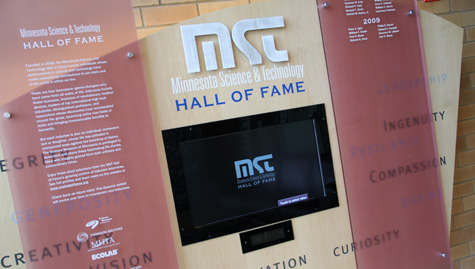
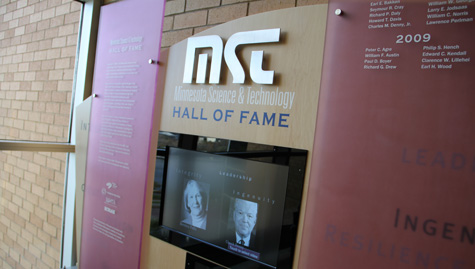
The Minnesota Science and Technology Hall of Fame is now featured in an exhibit at the Science Museum of Minnesota.
